
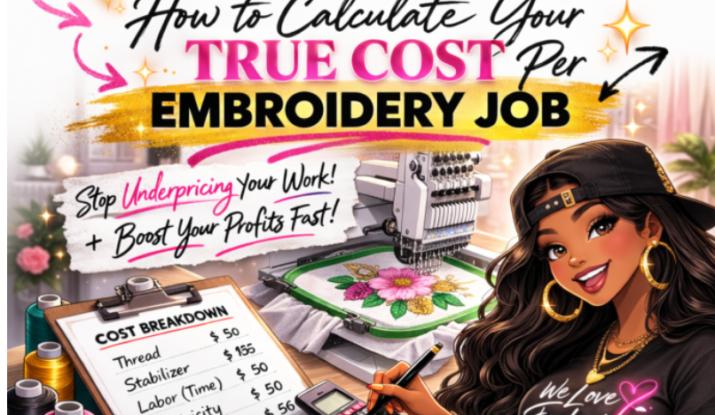

If you’re pricing embroidery based on what everyone else charges, we need to talk.
I did that when I first started, too.
And guess what?
I was underpricing myself—not by a little, but by a lot.
Over time, I realized that pricing based on competitors doesn’t tell you what a job actually costs you to produce. Every shop has different expenses, equipment, and labor requirements.
Today, I want to break down how to calculate your true cost per embroidery job so you can price with confidence instead of fear.
Step 1: Stop Looking at Stitch Count Alone
Stitch count is useful because it helps estimate machine time, but it doesn’t tell the whole story.
It does not account for:
- Thread cost
- Stabilizer cost
- Labor time
- Electricity usage
- Machine wear and maintenance
- Actual profit
If you’re pricing based on stitch count alone, you’re missing a large portion of your real expenses.
Step 2: Break Down Your Real Costs
A better approach is to calculate the actual costs involved in producing each order.
Thread
How much did the cone cost?
How many stitches can you realistically get from that cone?
When you break the cost down per job, it may seem small, but it still affects your bottom line.
Stabilizer
Consider the type of stabilizer you’re using:
- Cutaway
- Tearaway
- Water-soluble
Every sheet costs money. Even if you only use part of a sheet, remember that the unused portion may not always be usable for another project.
Labor (Yes, Pay Yourself)
This is where many embroiderers undervalue their work.
Ask yourself:
How long did this job really take?
Be sure to include:
- Hooping
- Thread trimming
- Pressing
- Packaging
- Customer communication
- Design setup
Your time has value, and your business should pay for it.
Electricity and Machine Wear
You don’t have to calculate this perfectly.
A simple flat estimate per job is usually enough to start.
Your embroidery machine experiences wear every time it runs, and maintenance costs are part of doing business.
Step 3: Add Profit—Not Just Break Even
Once you’ve calculated your costs, it’s time to add profit.
A simple formula looks like this:
Cost + Labor + Profit = Selling Price
If your total cost is $25 and you charge $28, you’re technically making money—but you’re not creating room for growth, equipment upgrades, or unexpected expenses.
Profit is not a bonus. It’s part of the price.
Step 4: Check Your Hourly Profit
After you’ve priced the job, calculate how much you earned per hour.
If you only made $12 per hour after expenses, you’ve created a job for yourself rather than a profitable business.
Tracking your hourly profit helps you identify which products are worth your time and which ones need to be repriced.
Why This Matters
Many embroiderers are incredibly talented.
Unfortunately, talent alone doesn’t guarantee profitability.
Too many people work long hours, take on difficult projects, and still struggle to make the income they deserve because they never calculated their true costs.
You don’t need to be the cheapest.
You don’t need to be the most expensive.
You simply need to be accurate.
Final Thoughts
When I started, I learned quietly.
From YouTube.
From blogs.
From trial and error.
If this article helps even one embroiderer stop underpricing their work, then it has done its job.
You’re not charging too much.
You’re building something real.
Price like it.